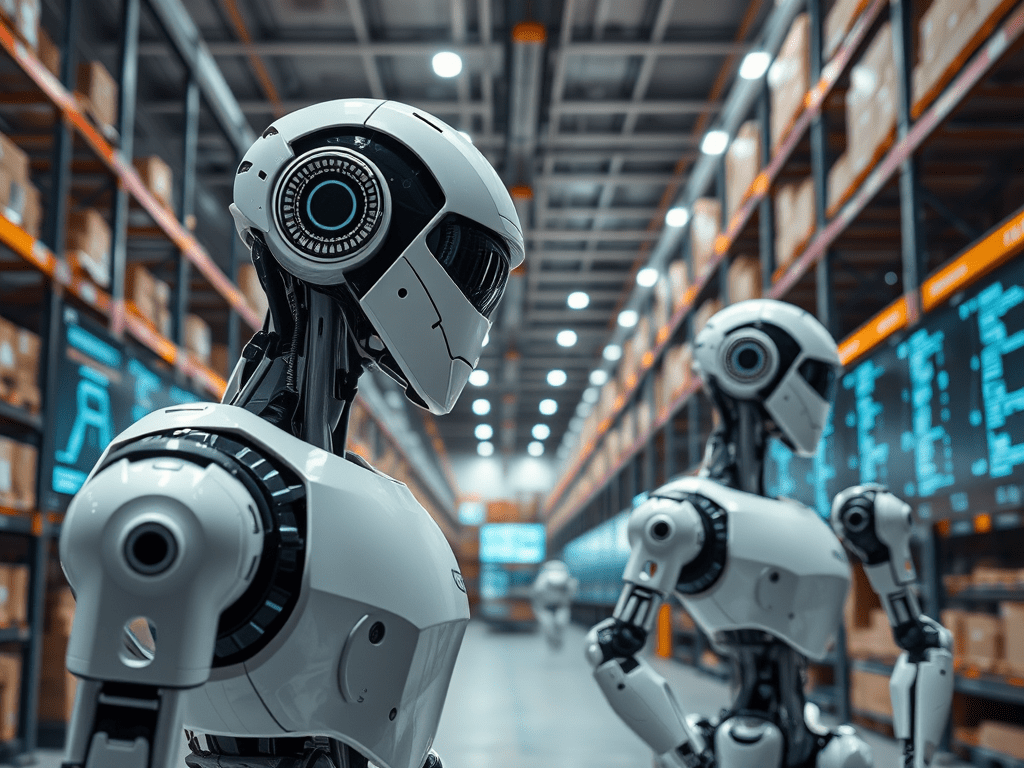
Amazon (AMZN) has just announced plans to replace over 600,000 workers in the U.S. with robots by 2033, aiming to automate 75% of its operations. The move could result in 160,000 job losses by 2027 — but it will also save the company nearly $12.6 billion between 2025 and 2027.
For many, this sounds alarming.
For investors, however, it signals something much bigger:
👉 We’re entering an era where Artificial Intelligence and robotics are no longer trends — they’re the infrastructure of the global economy.
⚙️ The Age of Intelligent Automation Has Begun
Amazon isn’t just cutting costs — it’s redefining efficiency. By implementing large-scale robotics and AI-driven logistics, the company is setting a new industrial standard that others will inevitably follow.
- Automation = Profit expansion. Reducing human labor dependency allows Amazon to scale faster, operate continuously, and minimize human error.
- Robots don’t rest. A single automated system can work 24/7, driving massive productivity gains.
- Predictable savings. The $12.6 billion saved by 2027 can be reinvested in innovation, cloud infrastructure, and AI research — all key long-term growth drivers.
- Data advantage. Every automated process generates new data, making AI systems even smarter — a compounding cycle of efficiency.
This isn’t just Amazon’s future — it’s a preview of what’s coming for every major logistics, retail, and manufacturing company worldwide.
💡 Why AI = The New Engine of Wealth
AI and robotics are no longer speculative technologies — they’re becoming core business assets.
Every major corporation is racing to:
- Automate labor-intensive tasks to reduce costs.
- Deploy AI in supply chains, optimizing delivery and forecasting.
- Develop predictive systems that learn from consumer behavior to increase sales and efficiency.
As adoption accelerates, companies leveraging AI will see exponential profit margins, while those that don’t will struggle to survive.
This structural shift is already creating a new class of long-term investment opportunities — not only in giants like Amazon or Nvidia but in the ecosystem of robotics manufacturers, AI software developers, and semiconductor suppliers powering the revolution.
🔍 What This Means for Investors
When large corporations move toward full automation, the investment implications are enormous:
- AI infrastructure demand will surge. Cloud capacity, semiconductors, and energy-efficient data centers become key profit drivers.
- Labor costs will decline — margins will rise. Companies that automate early will enjoy superior earnings growth.
- AI-driven companies will dominate indexes. The next generation of “blue chips” will be defined by how deeply they integrate AI.
- The market will reward innovation. Investors who understand and position early will capture the compounding growth others will only read about later.
This is where intelligent capital allocation matters most — knowing which companies are real innovators, and when to enter before the crowd does.
🧠 Where My Strategy Fits In
I’m Rachel Miller Cole, a professional trader and market analyst. I help investors across Central Europe, Canada, the USA, and the UK position themselves at the intersection of innovation and opportunity.
My approach combines:
- AI-powered market analytics to identify early signals in tech, robotics, and automation trends.
- Human strategic insight to manage timing, sentiment, and macro risk — things AI alone can’t do.
- Diversified exposure across sectors driving automation: cloud infrastructure, industrial robotics, semiconductor production, and logistics optimization.
Together, this hybrid model captures both short-term momentum and long-term structural growth — giving investors a disciplined way to profit from the AI revolution without taking uncontrolled risks.
🚀 The Bigger Picture: AI Is Rewiring the Global Economy
Let’s be clear — Amazon’s announcement isn’t about layoffs.
It’s about transition. The same shift that replaced manual labor with machines in the 20th century is now happening on an intelligent, digital level.
The winners in this transition will be:
- Companies that harness AI to scale faster than competitors.
- Investors who understand where to allocate before automation becomes universal.
- Individuals who adapt and align with innovation — not against it.
AI isn’t replacing opportunity. It’s creating a new class of it — for those who know where to look.
📈 The Bottom Line
Amazon’s move to replace 600,000 workers with robots is not a story about loss — it’s a signal of where the world is going next.
AI isn’t just reshaping technology. It’s redefining value, efficiency, and wealth itself.
The sooner you position yourself within that shift, the more upside you capture as automation becomes the global standard.
If you want to learn how AI-driven strategies can strengthen your portfolio and generate consistent long-term growth, I’ll show you exactly how.
💬 Message me with “AI STRATEGY”
and I’ll prepare a personalized outline showing:
- The top AI sectors with real growth potential
- How automation will impact global markets in the next 3 years
- How to position your portfolio now to benefit from the trend
Rachel Miller Cole
Professional Trader & Market Analyst
Helping investors in Central Europe, Canada, the USA, and the UK turn innovation into opportunity — and AI into real returns. 🌍📊








 Rachel Cole - Blog
Leave a comment