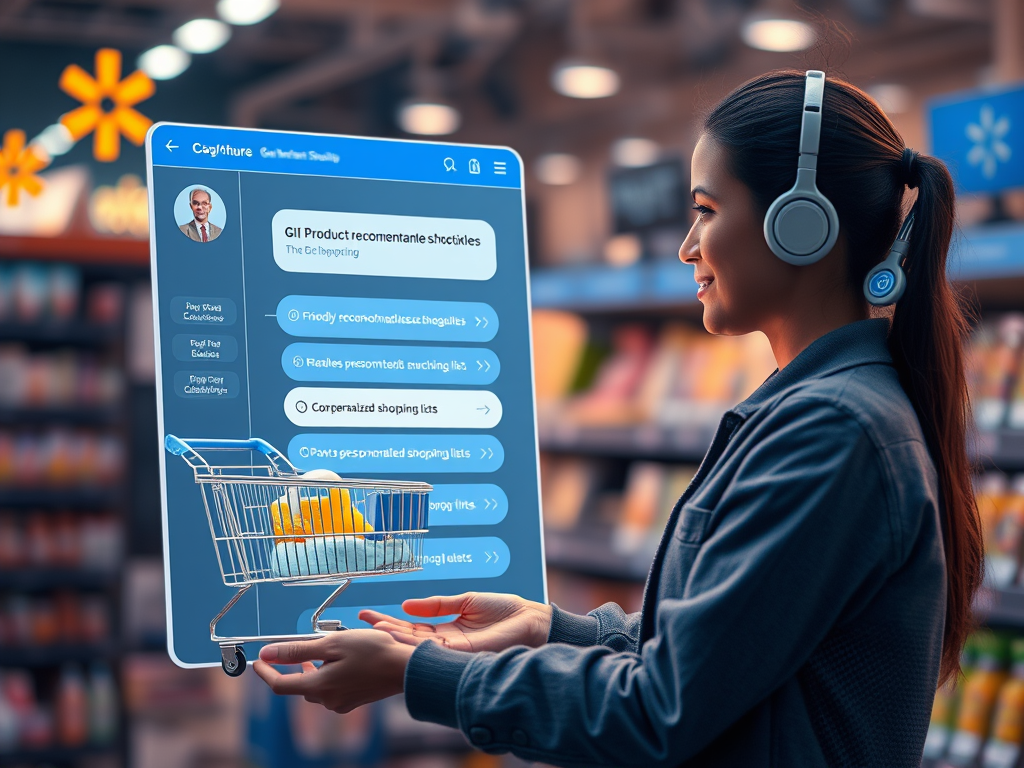
Walmart’s partnership with OpenAI — enabling customers to shop directly through ChatGPT — is far more than a PR headline. It’s a concrete step toward conversational commerce, and a vivid demonstration of how AI is turning from “nice-to-have” into a fundamental engine of revenue, margins and customer lock-in. For investors, that makes this one of the most important themes of the next decade.
Below I explain how this works, why it matters, the investment opportunities and risks, and exactly how I would help you put a disciplined plan in place to capture the upside — without gambling.
How the Walmart × OpenAI deal actually changes retail (in simple terms)
- Conversational interface: Customers ask ChatGPT for product recommendations, price comparisons, and personalized shopping lists — then complete purchases without leaving the chat.
- Personalization at scale: AI uses purchase history, browsing signals and real-time context (e.g., location, time of day) to recommend products that convert at higher rates.
- Frictionless checkout: Integration with payment/loyalty systems shortens the conversion funnel — less cart abandonment, higher average order value.
- Supply & demand intelligence: AI can surface inventory constraints, recommend substitutions, and trigger dynamic pricing or fulfillment decisions.
- New monetization: Sponsored product placements, in-chat promotions, and affiliate-like fees become native revenue streams.
In short: AI converts attention into transactions more efficiently, and the company that nails the UX + logistics wins a structural advantage.
How modern AI systems power this (brief, non-technical explainer)
- Foundation models (large language models like ChatGPT) are trained on vast text/data to understand and generate human-like language.
- Fine-tuning & retrieval: Retail-specific data (catalogues, inventory, pricing, reviews) is injected so the model answers accurately and in-brand.
- Real-time systems: The model connects to APIs for stock, pricing, order status and payments — producing answers that are not just plausible, but actionable.
- Feedback loops: Every chat/refinement yields data that improves recommendations — personalization improves over time, increasing lifetime value per customer.
Think of it as a super-smart salesperson that knows every product, every promotion, and every customer’s past purchases — and can act instantly.
Why this is a structural, not cyclical, investment theme
- Behavioral shift: Consumers increasingly prefer conversational interfaces (voice/ chat). Early adoption begets further adoption.
- Cost efficiency: Automated service reduces customer support costs and increases conversion rates.
- Network effects: More users → more data → better recommendations → more users. That feedback loop creates durable advantages.
- Ecosystem monetization: Beyond retail margins, there are ad revenues, payment fees, and premium services (subscriptions, express fulfilment).
- AI infrastructure tailwinds: Demand for high-performance chips, cloud inference, and enterprise AI tools rises — benefiting an entire supply chain.
Put simply: you’re not just investing in one feature — you’re investing in how commerce will be done.
Investment opportunities (who benefits)
Direct retail plays
- Walmart (WMT): Scale + physical omnichannel footprint + logistics. If Walmart captures ChatGPT-driven commerce, it accelerates share gains vs. pure e-commerce players.
- Amazon (AMZN): Competing moat — watch signs of parity and cross-platform competition.
AI & infrastructure
- NVIDIA (NVDA): GPUs for training and inference (critical for LLMs).
- Cloud providers (MSFT, AMZN, GOOGL): Hosting, inference, fine-tuning and enterprise AI services. Microsoft in particular (if it deepens OpenAI ties) is strategically relevant.
Payments & fintech
- Visa / Mastercard / PayPal: Increased transaction volume; new in-chat payment flows.
Retail ecosystem
- Logistics & fulfillment (UPS, Kuehne + Nagel, regional players) — faster fulfillment and returns optimization matter.
- Retail software/CRM providers — companies providing personalization, search and recommendation stacks.
Thematic funds / ETFs
- AI/robotics/cloud ETFs, consumer retail ETFs, and commodity/transportation funds for indirect exposure.
Risks you must understand
- Execution risk: Integration between AI and checkout, inventory and returns is technically and operationally hard. Not every partnership succeeds.
- Regulation & privacy: Data sharing rules (EU GDPR, UK rules) and potential regulation of AI ads could limit monetization.
- Competition: Amazon, Apple, Google and China-based players will push back aggressively.
- Monetization timing: Revenue lift can be slow to materialize; adoption curves vary by demographic and region.
- Dependence on infrastructure: AI costs (compute) can be high; margins depend on managing those costs.
Good investing is as much about managing these risks as it is about capturing upside.
Practical investment strategies — how to position (by profile)
Conservative / Income-oriented
- Small, measured exposure (2–5% of portfolio) to large-cap retailers and payment processors.
- Favor dividend-paying majors and diversified AI/cloud ETFs for indirect upside.
Balanced
- 5–10% exposure split across: Walmart, cloud providers, NVIDIA and a retail/AI ETF.
- Use staged buys (DCA) across earnings seasons and product announcement windows.
Aggressive / Thematic
- 10–20% exposure with selective bets on infrastructure (NVDA), cloud (MSFT), and high-conviction retail names — combined with options for leverage or downside protection.
Tactical
- Trade around catalyst windows: Salesforce/earnings, Walmart quarterly results, OpenAI/Microsoft announcements, and major shopping seasons (Black Friday, Prime Day, Christmas).
How I help clients capture this theme (my process)
I’m Rachel Miller Cole — professional trader & market analyst. Here’s the step-by-step I use with clients:
- Diagnostics: Quick portfolio health check (allocation, concentration, tax jurisdiction — Central Europe, Canada, US, UK).
- Target exposure: Recommend a thematic allocation based on your horizon and risk tolerance.
- Execution plan: Staged entry (DCA), position sizing rules, and tactical hedges (short-dated puts, protective collars).
- Ongoing monitoring: We track adoption metrics (chat-commerce conversion rates, ARPU uplift, ad revenue signals) and adjust.
- Reporting & education: Monthly performance review and clear explanations — you always know why we act.
Simple starter plan (example for a balanced investor)
- Step 1 — Allocate 6% of portfolio to the theme: 2% Walmart, 1.5% NVIDIA, 1.5% Cloud provider (MSFT/AMZN split), 1% AI/retail ETF.
- Step 2 — DCA over 6–8 weeks (buy equal tranches weekly) to reduce timing risk.
- Step 3 — Hedge 20% of the theme allocation with short-dated puts if volatility spikes.
- Step 4 — Review after earnings season and rebalance if any holding exceeds target by >4%.
(That’s illustrative — I’ll customize to your situation.)
Final thought — why act now
The Walmart × OpenAI deal is not just a tech pilot; it’s a real-world monetization pathway for conversational AI in commerce. The companies that master the integration of language models, payments and logistics will earn higher conversion, deeper loyalty and new revenue streams. That is a multi-year structural growth story, and early, disciplined positioning will likely outperform passive waiting.
If you want to participate intelligently—not speculate—I’ll build a personalized plan: target allocation, exact instruments (ETFs, stocks, options), staged entry schedule and risk controls — tailored for investors in Central Europe, Canada, the USA and the UK.
Reply with “AI RETAIL” and I’ll send a one-page plan within 48 hours with concrete entry points and the first tranche size. No hype — just a clear, professional path to capture this shift.
—
Rachel Miller Cole
Professional Trader & Market Analyst
Helping investors turn structural tech shifts into disciplined, risk-managed returns. 🌍📊







 Rachel Cole - Blog
Leave a comment